August 21, 2026
By Lane Kimble
MILWAUKEE — More than 2.1 million fans have gone to see the Brewers at American Family Field so far this season.
Jordan Swanson knows plenty of them are also watching his work.
“The interchange is right outside their front door,” Swanson said of the Brewers’ home field. “Lots of people come to this state to go to that stadium, so to be part of building a nice looking roadway that’s clean and updated and not falling apart is awesome.”
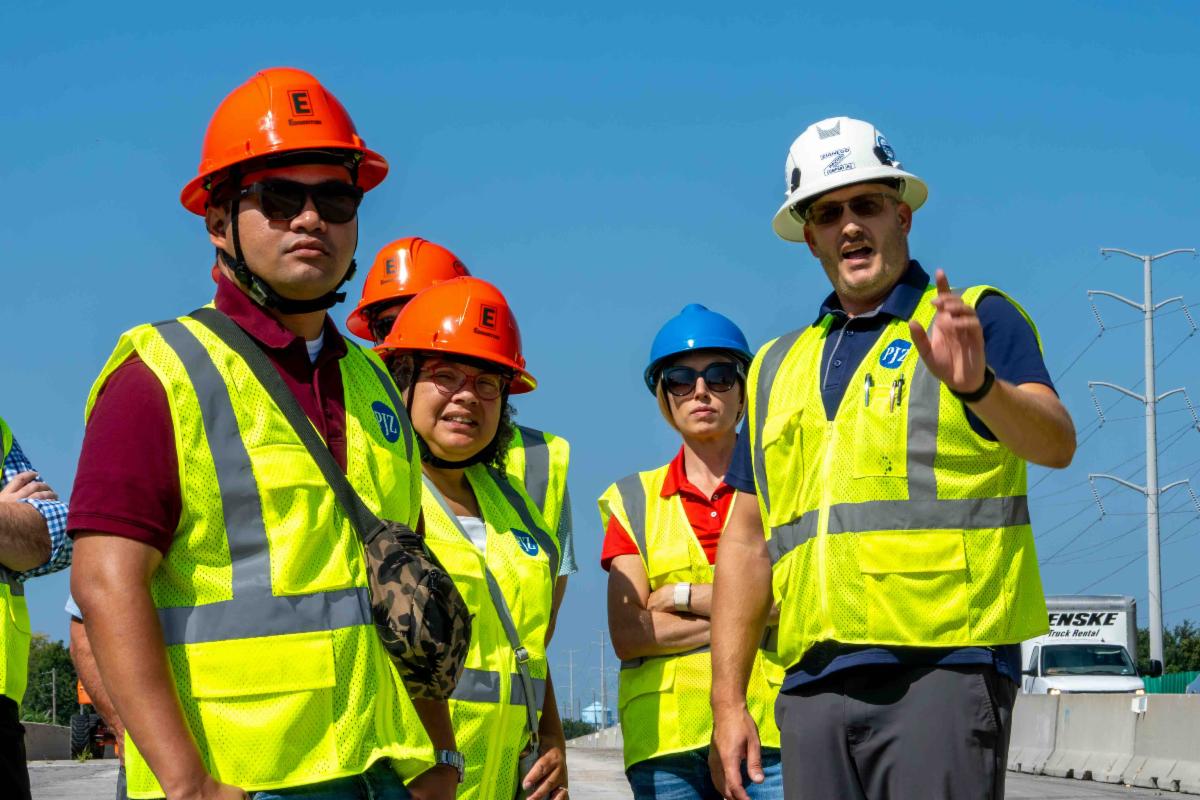
Swanson is the Director of Engineering for Edgerton Contractors, one of the main subcontractors on the massive I-94 East-West reconstruction.
He helped lead a project tour with WTBA staff, WisDOT, and a half-dozen state lawmakers Thursday as thousands of cars whooshed by along I-94. Many were headed to AmFam Field for a matinee against the Mariners.
The tour began in the project field office for a briefing and Q&A session before going to the early west leg of the project, where prime contractor Zignego Group is coordinating with Swanson’s Edgerton Contractors and Zenith Tech crews.
“It’s tough. The constant noise of the interstate, the traffic, you’ve really got to focus on the work you’re doing because it’s kind of all consuming sometimes,” Swanson said.
Crews started work last fall to expand 3 ½ miles of the interstate from six to eight lanes, replace pavement and bridges that are 60 years old, and convert the Stadium Interchange into a diverging diamond. They won’t be done until at least 2033.
Equipment operators and laborers work day and night along traffic that’s limited to 50 MPH, divided by a lone concrete barrier wall.
“If you could close the freeway completely, it would be way cheaper and way faster, but you can’t just shut traffic off,” Swanson said.
Beyond the logistical impossibilities of closing a major freeway that 175,000 vehicles use every day, there’s the financial challenge, Southeast Freeways Construction Chief Jason Roselle explained.
The state has to break up the $1.8 billion project into financially manageable chunks, with three or four more major portions left to bid.
“I know there’s construction fatigue,” Roselle told the group of lawmakers. “But it’s a really good thing that we’re getting all this funding and we’re able to do these projects because there’s a lot of infrastructure that needs work.”
Continuing to fund the Southeast Mega program will be critical to keeping I-94 East-West on schedule. WisDOT could offset potentially two years in delays and $22 million in added costs if lawmakers approve spending for other elements of the project in the next two state budgets, Secretary Kristina Boardman told the Transportation Projects Commission this month.
The I-94 work stretches to 27th Street in the east, where the tour group watched Zenith Tech, Inc. and a host of subs continue building a brand new overpass. They also learned about the significant utility hurdles crews face, such as moving ATC electrical lines and a vast array of underground pipes.
All told, it’s a complicated project that will take time, Zignego Group Project Manager Justin Thomas told lawmakers.
“We’re building this for your safety and eventually this will help you get from point A to B faster,” Thomas said. “It will be a long corridor project, but we are out here every day and it’s going to be great when it’s done. Patience is key for everyone involved.”
A lane reduction this week will allow crews to finish delicate retaining wall work along Wood National Cemetery and begin laying permanent concrete in the eastbound lanes. Paving those will take much of 2027, with westbound paving scheduled for 2028. Overall project completion is still seven years off.
Swanson understands that’s a long time–and a lot of Brewers seasons–for drivers to put up with cones, barricades and delays but he knows the finished product will turn frustration into fandom for anyone who uses I-94 for generations to come.
“When it’s nice and (the roadway design) makes sense and it feels safe, that’s a good thing. I want Wisconsin to look that way,” Swanson said. “When my friends come in from out of state, they’ll say, ‘Man, you’ve got nice roads,’ and I’ll be able to say I helped build those roads.”